Cole Page
Credit Analyst · cole.page.2027@anderson.ucla.edu · colehpage.com
Vestis: Hold the Term Loan B-1, Add at 97.5
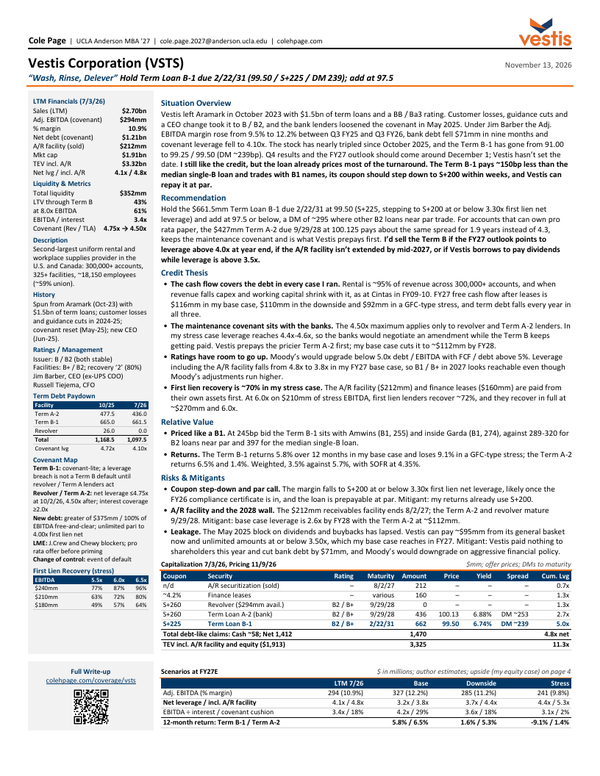
Hold the Term Loan B-1 at 99.50 (S+225, DM 239) and add at 97.5. The cash flow covers the debt in every case I ran, but the loan already trades with B1 names, its coupon is about to step down and Vestis can repay it at par.
The Call
Hold the $661.5mm Term Loan B-1 due 2/22/31 at 99.50 (S+225, stepping to S+200 at or below 3.30x first lien net leverage) and add at 97.5 or below, a DM of ~295 where other B2 loans near par trade. For accounts that can own pro rata paper, the $427mm Term A-2 due 9/29/28 at 100.125 pays about the same spread for 1.9 years instead of 4.3, keeps the maintenance covenant and is what Vestis prepays first. I'd sell the Term B if the FY27 outlook points to leverage above 4.0x at year end, if the A/R facility isn't extended by mid-2027, or if Vestis borrows to pay dividends while leverage is above 3.5x.
I still like the credit, but the loan already prices most of the turnaround. The Term B-1 pays ~150bp less than the median single-B loan and trades with B1 names, its coupon should step down to S+200 within weeks, and Vestis can repay it at par. The upside from the turnaround now sits in the equity, which I wrote up separately (BUY at $14.09).
Situation
Vestis left Aramark in October 2023 with $1.5bn of term loans and a BB / Ba3 rating. Customer losses, guidance cuts and a CEO change took it to B / B2, and the bank lenders loosened the covenant in May 2025. Under Jim Barber the Adj. EBITDA margin rose from 9.5% to 12.2% between Q3 FY25 and Q3 FY26, bank debt fell $71mm in nine months and covenant leverage fell to 4.10x. The stock has nearly tripled since October 2025, and the Term B-1 has gone from 91.00 to 99.25 / 99.50 (DM ~239bp). Q4 results and the FY27 outlook should come around December 1; Vestis hasn't set the date.
Vestis rents and launders uniforms and supplies mats, towels, restroom and first-aid products to more than 300,000 accounts from 325+ facilities and ~3,300 routes. The U.S. was 91% of FY25 revenue and Canada 9%. Rental is 95% of revenue; in 9M FY26 workplace supplies were 63% and uniforms 37%. Vestis describes itself as the second-largest provider behind Cintas, with UniFirst third.
Customers left faster than new ones came in. Revenue fell from $2,805.8mm in FY24 to $2,734.8mm in FY25 even with a 53rd week ($51.6mm). Moody's tied its May 2025 downgrade to net customer losses and pricing pressure linked to service problems, high senior management turnover and inconsistent delivery against guidance.
Margins and covenant room went with them. Adj. EBITDA fell from $352.9mm (12.6%) in FY24 to $257.4mm (9.4%) in FY25. The bank lenders reset the covenant in May 2025 (Amendment No. 2) to 5.25x, stepping to 4.50x from Q1 FY27, and blocked dividends; the $18mm dividend was suspended.
| Quarter | Revenue | Year over year | Adj. EBITDA | Margin |
|---|---|---|---|---|
| Q1 FY25 | 683.8 | -4.8% | 81.1 | 11.9% |
| Q2 FY25 | 665.2 | -5.7% | 47.6 | 7.2% |
| Q3 FY25 | 673.8 | -3.5% | 64.0 | 9.5% |
| Q4 FY25 (14 weeks) | 712.0 | +4.0% (-3.5% same weeks) | 64.7 | 9.1% |
| Q1 FY26 | 663.4 | -3.0% | 70.4 | 10.6% |
| Q2 FY26 | 659.4 | -0.9% | 74.5 | 11.3% |
| Q3 FY26 | 661.7 | -1.8% | 80.9 | 12.2% |
| Q4 FY26 guide | ~662 | ~flat same weeks | 84-89 | ~13% |
$ in millions. Q4 FY26 revenue is the CFO's indication; EBITDA is the guide.
New management. Jim Barber, formerly chief operating officer of UPS, became CEO on 6/2/25 after Kim Scott left and Chairman Phillip Holloman, a former president and COO of Cintas, served as interim CEO. Russell Tiejema became CFO on 9/28/26, and Vestis reaffirmed its FY26 outlook that day.
Costs. The transformation plan launched in December 2025 targets at least $75mm of annual savings entering FY27, about $50mm of it realized in FY26, plus ~$10mm a year from outsourcing corporate support starting in FY27. The CFO said in August that Q4 already carries ~$20mm of the program, so the Q4 guide reflects the full run-rate and there is no further $25mm to add for FY27.
Pricing discipline. Vestis is exiting accounts that miss its return thresholds. Barber said in August that it kept about 75% of the low-margin volume it repriced. In Q3 FY26 pounds processed fell 4.5%, revenue per pound rose $0.04 to $1.42 and cost per pound was flat at $1.24.
Cash. The FY26 free cash flow guide went from $50-60mm in December 2025 to $160-170mm in August, helped by a working capital release. In May management said FY27 starts from the Q4 exit rate, and the Q4 guide of $84-89mm annualizes to $336-356mm. In August the CFO was more careful and called the ~$81mm a quarter Vestis was earning going into Q4 a stable place to start.
| Date | Event | Amount | Detail |
|---|---|---|---|
| Sep-23 | Spin financing: Term A-1 and Term A-2 | 1,500 | Term A-2 $700mm due 9/2028; revolver $300mm |
| Feb-24 | Term B-1 refinances the Term A-1 | 800 | S+225, 99.75, due 2/22/31; 101 soft call expired Aug-24 |
| Aug-24 | $250mm A/R securitization | ~216 | Initial proceeds; terminates 8/2/27 |
| May-25 | Amendment No. 2 (bank lenders only) | – | Covenant reset; dividends and buybacks blocked; receivables capped at $250mm |
| 10/3/25 | Term loans and revolver | 1,168.5 | Covenant leverage 4.72x |
| 7/3/26 | Term loans | 1,097.5 | Covenant leverage 4.10x; revolver undrawn |
| Aug-26 | Covenant relief period ends | – | Two straight quarters at or below 4.50x (4.47x, 4.10x); the dividend, buyback and receivables limits fall away |
Credit Thesis
The cash flow covers the debt in every case I ran. Rental is ~95% of revenue across 300,000+ accounts, and when revenue falls capex and working capital shrink with it, as at Cintas in FY09-10. FY27 free cash flow after leases is $116mm in my base case, $110mm in the downside and $92mm in a GFC-type stress, and term debt falls every year in all three.
The maintenance covenant sits with the banks. The 4.50x maximum applies only to revolver and Term A-2 lenders. In my stress case leverage reaches 4.4x-4.6x, so the banks would negotiate an amendment while the Term B keeps getting paid. Vestis prepays the pricier Term A-2 first; my base case cuts it to ~$112mm by FY28.
Ratings have room to go up. Moody's would upgrade below 5.0x debt / EBITDA with FCF / debt above 5%. Leverage including the A/R facility falls from 4.8x to 3.8x in my FY27 base case, so B1 / B+ in 2027 looks reachable even though Moody's adjustments run higher.
First lien recovery is ~70% in my stress case. The A/R facility ($212mm) and finance leases ($160mm) are paid from their own assets first. At 6.0x on $210mm of stress EBITDA, first lien lenders recover ~72%, and they recover in full at ~$270mm and 6.0x.
Capital Structure
Capitalization 7/3/26, pricing 11/9/26. $mm; offer prices; DMs to maturity.
| Coupon | Security | Rating | Maturity | Amount | Price | Yield | Spread | Cum. Lvg |
|---|---|---|---|---|---|---|---|---|
| n/d | A/R securitization (sold) | 8/2/27 | 212 | 0.7x | ||||
| ~4.2% | Finance leases | various | 160 | 1.3x | ||||
| S+260 | Revolver ($294mm avail.) | B2 / B+ | 9/29/28 | 0 | 1.3x | |||
| S+260 | Term Loan A-2 (bank) | B2 / B+ | 9/29/28 | 436 | 100.13 | 6.88% | DM ~253 | 2.7x |
| S+225 | Term Loan B-1 | B2 / B+ | 2/22/31 | 662 | 99.50 | 6.74% | DM ~239 | 5.0x |
| Total debt-like claims | 1,470 | 4.8x net |
Cash ~58 and net debt-like claims 1,412 on LTM covenant Adj. EBITDA of $294mm. TEV including the A/R facility and equity ($1,913) is 3,325, or 11.3x. Total liquidity is $352mm and EBITDA covers interest 3.4x.
Relative Value
| Loan | Margin | Maturity | Bid / offer | Yield | DM today | DM after step |
|---|---|---|---|---|---|---|
| Term B-1 ($661.5mm) | S+2.25%; S+2.00% at ≤3.30x first lien | 2/22/31 | 99.25 / 99.50 | 6.74% | 239 | 214 |
| Term A-2 ($427mm, 9/30) | S+2.60% incl. CSA; S+2.35% below 4.0x | 9/29/28 | ~99.38 / 100.13 | 6.88% | 253 | 228 |
Bloomberg BVAL, 11/9/26; yields at flat SOFR; DMs to maturity at the offer. The Term A-2 grid steps down once the FY26 compliance certificate shows leverage below 4.0x (~3.7x on my estimate). Its bid is inferred from the 99.75 mid in Bloomberg's loan search.
The market already prices an upgrade. At 245bp bid the Term B-1 sits with Amwins (B1, 255) and inside Garda (B1, 274), against 289-320 for B2 loans near par and 397 for the median single-B loan, whose margin is S+350 against Vestis' S+225. Over the last 12 months the loan went from ~94.7 to 99.38 while the Morningstar LSTA B loan index fell about a point, so the market has already paid lenders for most of the turnaround.
The Term A-2 doesn't trade inside the Term B. ADT's Term A trades at 191bp against 211-218 for its Term Bs, and Aramark's at 164 against 182-196. Vestis' Term A-2 trades level or wide of its Term B because the May 2025 amendment repriced the bank debt and left the Term B alone. At the offer it pays ~253bp today and ~228 once the grid steps down, against 239 and 214 for the Term B, for 1.9 years instead of 4.3. It trades about three-quarters of a point wide, three times the Term B, so it suits a buyer who will hold it to maturity.
Technicals. Bloomberg's holder data covers ~80% of the Term B. Vehicles named as CLOs hold at least a third, and the largest holders are CLO and loan managers (Palmer Square, Battalion, Blue Owl, Neuberger Berman, Apollo). That supports the price while Vestis is stable at B2, but a Moody's cut to B3 would leave the loan one notch from the Caa1 bucket CLOs have to limit, and I'd expect them to sell early.
| 12-month total return | Upside | Base | Downside | Stress | Weighted |
|---|---|---|---|---|---|
| DM change at horizon (bp) | -50 | 0 | +150 | +600 | |
| Term B-1 horizon price | 100.3 | 98.9 | 94.7 | 83.9 | |
| Term A-2 horizon price | 100.1 | 99.8 | 98.6 | 94.7 | |
| Term B-1 total return | 7.3% | 5.8% | 1.6% | -9.1% | 3.5% |
| Term A-2 total return | 6.7% | 6.5% | 5.3% | 1.4% | 5.7% |
Weights 15 / 50 / 25 / 10 (mine); offer prices 99.50 and 100.125. Priced to maturity one year forward at flat SOFR (4.35%), at today's offer DM plus the change shown, with each loan on the margin its case earns. Stress at +600bp is roughly where a B3 / CCC loan would trade; it does not price an amend-and-extend of the Term A-2's 2028 maturity.
Why the Term B's weighted return is below SOFR. The par call caps the upside, since 50bp of tightening only gets the price to ~100.3; the step-down to S+200 costs about a point in the base case; and my cases add up to ~90bp of expected widening, which is cautious. I use the weights to rank the two loans more than to forecast. Without them the comparison still holds: the Term B earns 0.6% more than the Term A-2 when things go well and loses ~10 points more in the stress.
Where I'd buy the Term B. At 97.5 its DM is ~295, in line with B2 loans near par, so the price would pay for Vestis staying a B2 rather than for an upgrade that hasn't happened. That is also close to its 97.9 average since issuance.
Covenants
Vestis Corporation borrows under the $300mm revolver, the Term A-2 and the Term B-1 (JPMorgan, agent). Wholly owned domestic restricted subsidiaries guarantee, and the collateral includes 100% of domestic subsidiary stock, 65% of first-tier foreign stock and mortgages on U.S. property worth $15mm or more. The Canadian subsidiary borrows under the revolver only and is not a guarantor. VS Financing, LLC is the bankruptcy-remote vehicle that buys receivables under the $250mm A/R facility, off balance sheet.
| Term | Revolver / Term A-2 | Term B-1 |
|---|---|---|
| Size / pricing | $300mm revolver and $436mm Term A-2 (from $700mm); S+10bp+1.50-2.50% on leverage | $661.5mm (from $800mm); S+2.25%, S+2.00% at or below 3.30x first lien |
| Maturity | 9/29/28; Term A-2 1.25% quarterly amortization (prepaid) | 2/22/31; 0.25% quarterly (prepaid); no springer |
| Maintenance | Net leverage ≤4.75x at 10/2/26, 4.50x after; coverage ≥2.0x | None (covenant-lite); standstill until the pro rata lenders act |
| Collateral | Pari first lien | Pari first lien |
| New debt / liens | Incremental: greater of $375mm / 100% of EBITDA, plus voluntary prepayments, plus unlimited to 4.00x first lien net; MFN expired | Same; no inside-maturity basket |
| Restricted payments | Unlimited at ≤3.50x; $95mm / 25% general; builder basket from $190mm / 50%; May-25 block lapsed after two quarters at ≤4.50x | Same; the block was a bank-only term |
| Sweeps | Term A-2: asset sales 100% above 3.50x first lien, 50% to 3.00x, none below | Same, plus excess cash flow 50% above 3.75x secured, 25% to 3.25x, none below |
| LME protection | J.Crew and Chewy blockers; pro rata offer before priming | Same; open-market buybacks allowed |
| Change of control | Event of default (40% of votes) | Same; prepayable at par |
Credit agreement as amended through Amendment No. 2 (5/1/25). The $250mm A/R facility ($212mm sold at 7/3/26) ends 8/2/27 and owns the receivables sold; receivables financing is uncapped now that the relief period has ended.
| Basket | Capacity ($mm) |
|---|---|
| Free-and-clear incremental (greater of $375mm / 100% of EBITDA) | ~375 |
| Reload for term loans voluntarily prepaid (~$400mm repaid since the spin) | up to ~400 |
| Ratio incremental to 4.00x first lien net (~3.2x at FY26E) | ~250 |
| General lien basket (greater of $150mm / 40% of EBITDA) | ~150 |
| Capital leases / purchase money (greater of $190mm / 50% of EBITDA) | ~190 |
| Receivables financing (the $250mm cap ended with the relief period) | uncapped |
Room for debt ahead of or pari with the Term B, on EBITDA of ~$313mm (FY26E). The pari incremental capacity matters less than the structurally senior pieces. The A/R facility and finance leases already sit ahead of the Term B on their own assets, and both can grow. That is why I treat leverage including the A/R facility as the real number for the loan.
Scenarios
Author estimates, no acquisitions or buybacks. $ in millions; FY26E EBITDA at the guide midpoint.
| LTM 7/26 | FY26E | Base FY27E | Base FY28E | Down FY27E | Down FY28E | Stress FY27E | Stress FY28E | |
|---|---|---|---|---|---|---|---|---|
| Revenue | 2,697 | 2,647 | 2,673 | 2,726 | 2,541 | 2,515 | 2,461 | 2,363 |
| Adj. EBITDA | 294 | 313 | 327 | 350 | 285 | 277 | 241 | 217 |
| % margin | 10.9% | 11.8% | 12.2% | 12.8% | 11.2% | 11.0% | 9.8% | 9.2% |
| FCF after leases | 150 | 116 | 136 | 110 | 105 | 92 | 76 | |
| Covenant net debt (year end) | 1,205 | 1,161 | 1,045 | 909 | 1,051 | 946 | 1,069 | 993 |
| Total net leverage | 4.1x | 3.7x | 3.2x | 2.6x | 3.7x | 3.4x | 4.4x | 4.6x |
| Net leverage incl. A/R facility | 4.8x | 4.4x | 3.8x | 3.2x | 4.4x | 4.2x | 5.3x | 5.5x |
| EBITDA cushion to covenant | 18% | 22% | 29% | 42% | 18% | 24% | 2% | -1% |
| EBITDA / cash interest | 3.4x | 4.2x | 5.4x | 3.6x | 4.2x | 3.1x | 3.1x | |
| Liquidity | 352 | 387 | 324 | 324 | 324 | 324 | 324 | 324 |
LTM covenant EBITDA adds back a $15mm Q2 FY25 bad debt charge. FY26E free cash flow is the implied change in covenant net debt. Securitization fees are added back in Adj. EBITDA but are cash costs.
Base case (consensus-like). FY27: revenue +1.0%, margin 12.25%, EBITDA $327mm, roughly the $327.6mm consensus and below the Q4 run-rate. Cash goes to the Term A-2 first. Leverage 3.2x (3.8x with the A/R facility). FY28: revenue +2%, margin 12.85% (consensus $352mm). The Term A-2 is ~$112mm and leverage 2.6x.
Upside (my equity case). FY27: EBITDA $360mm (13.45%): roughly the Q4 FY26 exit rate held for a year, with the ~$10mm of outsourcing savings covering wage inflation. Leverage 2.8x. This is the case behind my equity call; for the loan I underwrite to the base case.
Downside (turnaround stalls). FY27: revenue -4%, margin 11.2%, EBITDA $285mm. Capex falls to 3.0% of revenue and working capital releases ~$16mm. Leverage 3.7x, cushion 18%, coverage 3.6x.
Stress (GFC-type). FY27-28: revenue -7% then -4% (-11% in total), margins 9.8% and 9.2%, EBITDA $241mm then $217mm, about 30% below FY26. Leverage reaches 4.4x and 4.6x, at or just past the 4.50x maximum, so the banks would need an amendment; the Term B is not in default and coverage stays above 3.1x. Including the A/R facility leverage is 5.5x.
| Consensus vs. my cases | FY26E | FY27E | FY28E |
|---|---|---|---|
| Consensus revenue | 2,650 | 2,697 | 2,782 |
| Consensus Adj. EBITDA | 308 | 328 | 352 |
| My base / upside Adj. EBITDA | 313 (guide) | 327 / 360 | 350 / 398 |
Street consensus as of 11/8/26. SOFR is flat at 4.35%, the forward-curve average through FY28 (3M Term SOFR is 4.05% today), with interest on beginning balances, the Term A-2 margin on the leverage grid and the Term B-1 at S+200 once first lien net leverage is at or below 3.30x. Excess cash repays the revolver, then the Term A-2, then the Term B-1, with $30mm of minimum cash. The A/R facility is renewed at $212mm and finance leases stay flat at ~$160mm. I model no excess cash flow sweep to the Term B; the percentage is zero at or below 3.25x secured.
Recovery
| Waterfall at the stress point | Amount | Recovery |
|---|---|---|
| Distressed EBITDA × multiple | 210 × 6.0x = 1,260 | |
| Less administrative costs (5%) | (63) | |
| A/R securitization (owns the receivables) | (212) | 100% |
| Finance leases (vehicles) | (160) | 100% |
| Value for first lien lenders | 825 | |
| Revolver (fully drawn) + Term A-2 + Term B-1 | 1,151 | 72% |
| Unsecured claims (trade, leases, pensions, litigation) | n/q | 0% |
$ in millions; hypothetical default after the stress case.
| First lien recovery | 5.0x | 5.5x | 6.0x | 6.5x | 7.0x |
|---|---|---|---|---|---|
| $180mm | 42% | 49% | 57% | 64% | 72% |
| $210mm | 54% | 63% | 72% | 80% | 89% |
| $240mm | 67% | 77% | 87% | 96% | 100% |
| $270mm | 79% | 90% | 100% | 100% | 100% |
| $300mm | 91% | 100% | 100% | 100% | 100% |
Revolver fully drawn; Term A-2 at its stress-case FY28 balance.
The multiple. Vestis trades at ~10x, UniFirst at ~12x and Cintas' offer values UniFirst at ~17x. A route business that needs a restructuring would sell for much less, so I use 6.0x with a 5.0-7.0x range.
What drives the answer. The A/R facility and the revolver. If Vestis defaults, the revolver is probably fully drawn and the receivables already belong to the securitization, which together take ~$500mm of value ahead of or alongside the Term B. That is why recovery is ~72% at $210mm and 6.0x even though the term loans alone would be only ~4x that EBITDA.
Ratings agencies. S&P rates the secured facilities B+ with a '2' recovery rating (70-90%, point estimate 80%), unchanged since the Term B was syndicated in January 2024. My ~72% sits at the low end because I assume the revolver is fully drawn at default.
Risks
Three national players, and the top two may merge. Cintas agreed in March 2026 to buy UniFirst for $155 in cash plus 0.772 Cintas shares (~$327 at 11/6, ~16.8x FY+1 EBITDA). Semafor reported on 10/27 that the FTC intends to sue to block it; the FTC says it has not voted. On 11/13 Seeking Alpha reported that the FTC will hold a "last rites" meeting with the companies, usually the last step before a suit. The companies agreed not to close before 12/11/26, the deal can be terminated after 1/10/27 (with extensions), and Cintas owes $350mm if regulators block it. UniFirst trades more than $90 below the offer, so the market is pricing real block risk. A block keeps three national players and rules out the two largest as buyers of Vestis, which matters little to a lender because a change of control is an event of default and repays the loan at par. Clearance creates a bigger competitor but also a messy integration Vestis can sell against.
Demand follows employment. Uniforms are rented per wearer, so the GFC is the stress test. Cintas' revenue fell 10% from FY08 to FY10 and its EBITDA 24%, and it stayed profitable throughout. My stress case takes Vestis' EBITDA down ~30% from FY26 because it enters with weaker margins and service.
| Cintas through the GFC | Revenue | Year over year | EBITDA | Margin |
|---|---|---|---|---|
| FY08 | 3,938 | 775 | 19.7% | |
| FY09 | 3,775 | -4.1% | 612 | 16.2% |
| FY10 | 3,547 | -6.0% | 586 | 16.5% |
| FY08-FY10 | -9.9% | -24.5% |
$ in millions; fiscal years end May; company filings.
Revenue is still shrinking. Pounds fell 4.5% in Q3 and the new sales model is unproven. Mitigant: the losses are partly deliberate exits, revenue per pound is rising, and my base case assumes only +1% revenue growth in FY27; the downside case takes revenue down 4%.
Covenant room for the banks. The 4.50x maximum starts in Q1 FY27, against 4.10x at 7/3/26 and ~3.7x on my FY26 estimate. Mitigant: my base case has a 29% EBITDA cushion at FY27, and a breach does not default the Term B until the bank lenders act.
The A/R facility sits ahead. $212mm of receivables are sold to a bankruptcy-remote vehicle, and another $134mm of unsold receivables are pledged to its purchasers, so the Term B's best working capital collateral belongs to someone else. If the facility lapsed in August 2027, Vestis would draw the revolver and leverage would rise ~0.7x. Mitigant: renewal in a base case is routine, and the revolver has $294mm available.
Coupon step-down and par call. The margin falls to S+200 at or below 3.30x first lien net leverage, likely once the FY26 compliance certificate is in, and the loan is prepayable at par. Mitigant: my returns already use S+200.
Leakage and layering. Vestis can add pari debt equal to the greater of $375mm and 100% of EBITDA, plus whatever term debt it has voluntarily prepaid, plus unlimited amounts to 4.00x first lien net, and it can put liens on another $150mm (or 40% of EBITDA). The May 2025 block on dividends and buybacks has lapsed, so it can pay ~$95mm from the general basket today and unlimited amounts at or below 3.50x, and Corvex, an activist, owns ~15% of the stock. Lenders can be bought out non-pro rata in the open market. Mitigant: the agreement blocks the J.Crew and Chewy moves, priming needs a pro rata offer, and Vestis has paid nothing to shareholders this year.
Labor is unionized. About 10,750 of ~18,150 employees (59%) are covered by 200+ collective bargaining agreements. Vestis paid $19.7mm into multiemployer pension plans in FY25, and three of its four largest plans (including Central States and the National Retirement Fund) are in critical status. No withdrawal liability is disclosed; it would be an unsecured claim behind the Term B.
All of the debt floats. Vestis has no interest rate hedges, so 100bp on SOFR is ~$11mm of interest, about 0.5x of coverage in my base case.
Litigation. A securities class action in Georgia over the 2023 spin survived the motion to dismiss in September 2025, and Law360 reported on 11/13/26 that Vestis and Aramark have agreed to settle it; the amount isn't public yet. A second in New York was partly dismissed on 7/31/26. No accrual is disclosed.
Ratings
| Date | S&P | Moody's | Notes |
|---|---|---|---|
| 1/31/24 | BB (stable); secured BB+, recovery '2' | Ba3 | Term B syndication |
| 5/7/24 | BB- (negative) | Guidance cut | |
| 5/12/25 - 5/14/25 | B+ (negative) | B2 (stable); facilities B2 | Moody's: debt / EBITDA ~6x |
| 12/17/25 | B (stable); facilities B+, recovery '2' (80%) | B2 (stable) | "Persisting operating challenges" |
Moody's would upgrade on sustained revenue and earnings growth, debt / EBITDA below 5.0x, EBITA margin ~6% and FCF / debt above 5%, and downgrade above 6.5x, on weaker liquidity or more aggressive financial policy. S&P and Moody's releases; Bloomberg for current issue ratings.
Monitoring
| Signal | Current | Term B action | Equity read-across |
|---|---|---|---|
| FY27 outlook (with Q4 results) | Consensus $328mm EBITDA | Review if the midpoint is below $300mm | Above $340mm supports the BUY |
| Covenant leverage | 4.10x (7/3/26) | Exit above 4.25x at a test date | Same |
| A/R facility renewal | Ends 8/2/27 | Exit if not extended by 6/27 | |
| Dividends / new debt | None since FY25 | Exit on debt-funded payouts above 3.5x | Buybacks would help |
| Ratings | B / B2 stable; facilities B+ / B2 | Review on a negative outlook; a cut to B3 brings CLO selling | |
| Amendments / LME | None since 5/25 | Exit on a non-pro rata proposal | |
| Price | 99.25 / 99.50 | Add at 97.5 or below; trim above par (repricing risk) |
Limitations
Loan prices, the peer screens and the ratings come from Bloomberg. Loan quotes can be stale, the Term A-2 bid is inferred from a mid, and the loan search's DM for the Vestis Term B does not reconcile with its own quote, so I use the quote.
I read the conformed credit agreement in Amendment No. 2. First lien leverage for the margin step-down is defined in the agreement but described as total leverage in the 10-Q, and I exclude finance leases.
Recovery is stylized. There is no liquidation analysis of rental merchandise or plants, and multiemployer withdrawal liability is not disclosed.
The cases use public filings, guidance and consensus. My upside case also reflects conversations with an investor who holds the equity.