Cole Page
Credit Analyst · cole.page.2027@anderson.ucla.edu · colehpage.com
QXO: The 2033 Term Loan Over the 2034 Notes
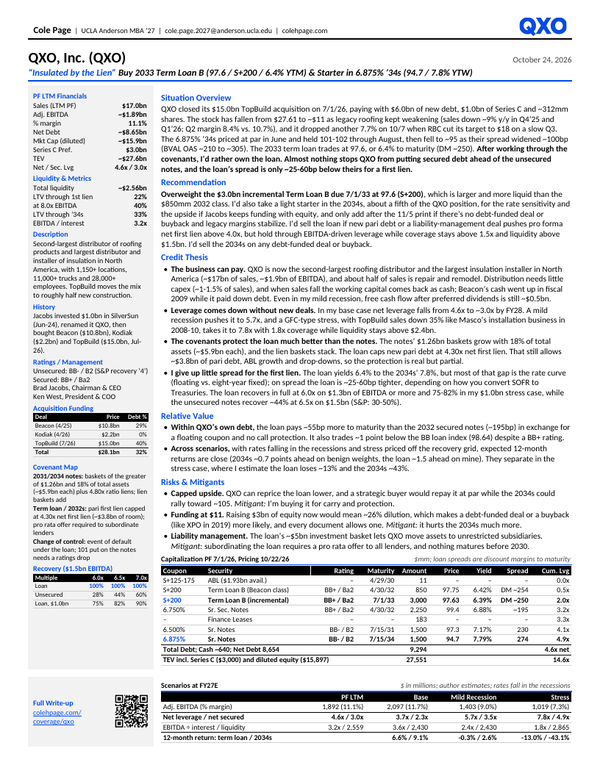
Overweight the 2033 Term Loan B at 97.6 for S+200, with a light starter in the 6.875% 2034s at 94.7. On spread the loan gives up only ~25-60bp for a first lien, and its documents limit what can go ahead of it.
The Call
Overweight the $3.0bn incremental Term Loan B due 7/1/33 at 97.6 (S+200), which is larger and more liquid than the $850mm 2032 class. I'd also take a light starter in the 6.875% 2034s at 94.7, about a fifth of the QXO position, for the rate sensitivity and the upside if Jacobs keeps funding with equity, and only add after the 11/5 print if there's no debt-funded deal or buyback and legacy margins stabilize.
I'd sell the loan if new pari debt or a liability-management deal pushes pro forma net first lien above 4.0x, but hold through EBITDA-driven leverage while coverage stays above 1.5x and liquidity above $1.5bn. I'd sell the 2034s on any debt-funded deal or buyback.
Situation
QXO closed its $15.0bn TopBuild acquisition on 7/1/26, paying with $6.0bn of new debt, $1.0bn of Series C and ~312mm shares. The stock has fallen from $27.61 to ~$11 as legacy roofing kept weakening (sales down ~9% y/y in Q4'25 and Q1'26; Q2 margin 8.4% vs. 10.7%), and it dropped another 7.7% on 10/7 when RBC cut its target to $18 on a slow Q3.
The 6.875% 2034s priced at par in June and held 101-102 through August, then fell to ~95 as their spread widened ~100bp (BVAL OAS ~210 to ~305). With 5.7 years of duration that explains nearly all of the ~6-point price drop, so almost all of the selloff is spread. The 2033 term loan trades at 97.6, or 6.4% to maturity (DM ~250).
After working through the covenants, I'd rather own the loan. Almost nothing stops QXO from putting secured debt ahead of the unsecured notes, and the loan's spread is only ~25-60bp below theirs for a first lien.
Credit Thesis
The business can pay. QXO is now the second-largest roofing distributor and the largest insulation installer in North America (~$17bn of sales, ~$1.9bn of EBITDA), and about half of sales is repair and remodel. Distribution needs little capex (~1-1.5% of sales), and when sales fall the working capital comes back as cash; Beacon's cash went up in fiscal 2009 while it paid down debt. Even in my mild recession, free cash flow after preferred dividends is still ~$0.5bn.
Leverage comes down without new deals. In my base case net leverage falls from 4.6x to ~3.0x by FY28. A mild recession pushes it to 5.7x, and a GFC-type stress, with TopBuild sales down 35% like Masco's installation business in 2008-10, takes it to 7.8x with 1.8x coverage while liquidity stays above $2.4bn.
The covenants protect the loan much better than the notes. The notes' $1.26bn baskets grow with 18% of total assets (~$5.9bn each), and the lien baskets stack. The loan caps new pari debt at 4.30x net first lien. That still allows ~$3.8bn of pari debt, ABL growth and drop-downs, so the protection is real but partial.
I give up little spread for the first lien. The loan yields 6.4% to the 2034s' 7.8%, but most of that gap is the rate curve (floating vs. eight-year fixed); on spread the loan is ~25-60bp tighter, depending on how you convert SOFR to Treasuries. The loan recovers in full at 6.0x on $1.3bn of EBITDA or more and 75-82% in my $1.0bn stress case, while the unsecured notes recover ~44% at 6.5x on $1.5bn (S&P: 30-50%).
Capital Structure
PF 7/1/26, pricing 10/22/26. $mm; loan spreads are discount margins to maturity.
| Coupon | Security | Rating | Maturity | Amount | Price | Yield | Spread | Cum. Lvg |
|---|---|---|---|---|---|---|---|---|
| S+125-175 | ABL ($1.93bn avail.) | 4/29/30 | 11 | 0.0x | ||||
| S+200 | Term Loan B (Beacon class) | BB+ / Ba2 | 4/30/32 | 850 | 97.75 | 6.42% | DM ~254 | 0.5x |
| S+200 | Term Loan B (incremental) | BB+ / Ba2 | 7/1/33 | 3,000 | 97.63 | 6.39% | DM ~250 | 2.0x |
| 6.750% | Sr. Sec. Notes | BB+ / Ba2 | 4/30/32 | 2,250 | 99.4 | 6.88% | ~195 | 3.2x |
| Finance Leases | 183 | 3.3x | ||||||
| 6.500% | Sr. Notes | BB- / B2 | 7/15/31 | 1,500 | 97.3 | 7.17% | 230 | 4.1x |
| 6.875% | Sr. Notes | BB- / B2 | 7/15/34 | 1,500 | 94.7 | 7.79% | 274 | 4.9x |
| Total Debt | 9,294 | 4.6x net |
Cash ~640 and net debt 8,654 on PF LTM adj. EBITDA of ~$1.89bn. TEV including the Series C ($3,000) and diluted equity ($15,897) is 27,551, or 14.6x.
Relative Value
The loan yields ~6.4% to maturity, ~140bp below the 2034s, but most of that gap is the rate curve, since the loan floats and the 2034s are fixed for eight years. On spread the loan is ~25-60bp tighter than the 2034s, depending on how you convert SOFR to Treasuries, and ~55bp wider than the 2032 secured notes on the same collateral. For that I get a first lien, no duration and a change-of-control default.
Against the loan market the 2033 loan trades about a point below the Morningstar LSTA BB loan index (98.64 on 10/23, its 52-week low) despite a BB+ rating, so it looks modestly cheap against other BB loans as well as within QXO's own debt.
The 2034s trade ~30-35bp wide of the BVAL BB curve and ~55bp inside the single-B curve at eight years, about where a BB-/B2 split rating should sit, so they are not cheap on their own; they do have 5.3 points of pull-to-par. They are the only leg that gains if Treasuries fall, and a re-rating to the BB curve would add ~2.5 points. The 2031s mature before every other piece of term debt and will be refinanced first, which explains part of the ~44bp of extra OAS on the 2034s.
Layering without default is the bad outcome I think is most likely. If a deal or buyback adds $2bn or more of secured debt, I estimate the 2034s lose 6-9 points and the loan 1-2.
Covenants
The 2031/2034 indenture lets QXO secure debt under a general basket and an acquisition basket that each grow at 18% of total assets (~$5.9bn each), plus ratio liens to 4.80x, and the lien baskets add. The loan caps new pari first-lien debt at 4.30x net first lien (~$3.8bn of room), and subordinating it needs a pro rata offer to every lender. The notes have nothing comparable.
| Basket | Document | Capacity ($mm) |
|---|---|---|
| General debt and lien basket (greater of $1.26bn, 18% of total assets) | 2031/2034 notes | ~5,900 |
| Acquisition debt basket (same grower; securable) | 2031/2034 notes | ~5,900 |
| Secured debt to 4.80x net secured leverage | 2031/2034 notes | ~4,900 |
| ABL basket (borrowing base or $2.5bn, plus $2.43bn) | 2031/2034 notes | ~4,900 |
| Pari first lien to 4.30x net first lien | Term loan, 2032 notes | ~3,800 |
| Term loan free-and-clear incremental plus reload | Term loan | ~3,600 |
Estimated total assets ~$33bn and covenant EBITDA ~$2.2bn. The notes' baskets add, so the 2031/2034 indenture would not stop QXO from adding well over $10bn of secured debt. The binding limits sit in the term loan and 2032 notes, which a simple majority can amend, and every ABL draw is excluded from the incurrence ratios.
| Term | Term Loans | 6.50% / 6.875% Notes '31 / '34 |
|---|---|---|
| Collateral | 1st on other assets; 2nd on ABL collateral | Unsecured |
| Maintenance | None | None |
| Debt / liens | Free-and-clear greater of $1.075bn / 1.0x + greater of $1.05bn / 15% of assets + reload for prepayments; pari 1L ≤4.30x; junior liens ≤4.80x | Ratio debt ≤5.05x or FCCR ≥2.0x; facilities $6.1bn + greater of $2.43bn / 1.0x; ABL basket ~$4.9bn; general and acquisition baskets greater of $1.26bn / 18% of assets, securable; liens at ≤4.80x; lien baskets add |
| Restricted payments | Unlimited at ≤3.55x net 1L; greater of $1.05bn / 15%; $175mm / 2.5% a year | Unlimited at ≤3.55x net total; greater of $1.26bn / 18%; $210mm / 3% a year |
| LME protection | Pro rata offer before subordination; no IP blocker | None found; unrestricted subsidiaries allowed up to the general basket |
| Change of control | Event of default | 101 only with a downgrade within 60 days; Permitted Holders include QXO and Jacobs; a widely held new parent does not trigger |
| Calls | Par; 101 soft call on incremental to ~1/1/27 | '31s 103.250 (7/28), 101.625, par; '34s 103.438 (7/29), 101.719 (7/30), par |
Term loan per the 4/29/25 credit agreement as amended; notes per the 6/17/26 indenture. The write-up also covers the ABL and the 2032 secured notes.
Scenarios
Author estimates at FY27E, no new acquisitions or buybacks, SOFR flat at 3.9%. $ in millions.
| PF LTM | Base | Mild Recession | Stress | |
|---|---|---|---|---|
| Adj. EBITDA (% margin) | 1,892 (11.1%) | 2,097 (11.7%) | 1,403 (9.0%) | 1,019 (7.3%) |
| Net leverage / net secured | 4.6x / 3.0x | 3.7x / 2.3x | 5.7x / 3.5x | 7.8x / 4.9x |
| EBITDA ÷ interest | 3.2x | 3.6x | 2.4x | 1.8x |
| Liquidity | 2,559 | 2,430 | 2,430 | 2,865 |
In the mild recession neither exit trigger fires, because the higher leverage comes from lower EBITDA and no new debt is added. On a to-maturity basis the loan would trade near 92. In the stress case all preferred dividends move to stock, working capital releases ~$340mm, and QXO holds cash instead of prepaying, so liquidity rises to ~$2.9bn. The company keeps paying interest; priced off the recovery grid, the loan would trade near 80 and the 2034s in the 40s.
| 12-month total return | Base | Mild | Stress | Layering | Weighted A | Weighted B |
|---|---|---|---|---|---|---|
| Treasuries / SOFR change (bp) | 0 / 0 | -75 / -100 | -150 / -200 | 0 / 0 | ||
| Loan DM / 2034s OAS at horizon (bp) | 240 / 250 | 375 / 450 | priced 80 / 47 | 275 / 400 | ||
| Term Loan B (97.6) | 6.6% | -0.3% | -13.0% | 4.9% | 2.3% | 4.2% |
| 6.875% 2034s (94.7) | 9.1% | 2.6% | -43.1% | 1.4% | 0.8% | 4.8% |
| 80 / 20 mix | 7.1% | 0.3% | -19.1% | 4.2% | 2.0% | 4.3% |
Weights A = 45 / 30 / 10 / 15 (mine); B = 70 / 20 / 5 / 5 (benign). Loan prices are to maturity; stress prices come from the recovery grid. Expected returns are close and depend on the weights. On benign weights the 2034s earn ~0.7 points more, and on mine the loan earns ~1.5 points more. The loan's advantage shows up on the downside, where it loses ~13% in my stress case against ~43% for the 2034s, and keeps most of its carry in the layering case while the 2034s earn ~1%.
Recovery
Term loan and secured notes, after a fully drawn ABL:
| EBITDA | 5.0x | 5.5x | 6.0x | 6.5x | 7.0x |
|---|---|---|---|---|---|
| $1,000 | 60% | 67% | 75% | 82% | 90% |
| $1,200 | 75% | 84% | 93% | 100% | 100% |
| $1,300 | 82% | 92% | 100% | 100% | 100% |
| $1,400 | 90% | 100% | 100% | 100% | 100% |
| $1,500 | 97% | 100% | 100% | 100% | 100% |
Unsecured notes, with $1.5bn of other unsecured claims:
| EBITDA | 6.0x | 6.5x | 7.0x | 7.5x | 8.0x |
|---|---|---|---|---|---|
| $1,000 | 0% | 0% | 0% | 0% | 7% |
| $1,200 | 0% | 3% | 15% | 28% | 41% |
| $1,300 | 3% | 17% | 30% | 44% | 58% |
| $1,400 | 15% | 30% | 45% | 60% | 75% |
| $1,500 | 28% | 44% | 60% | 76% | 91% |
Enterprise value less 5% administrative costs; the ABL ($1.0bn drawn) takes current assets first; term loans, secured notes and leases ($6.3bn) come next; unsecured notes share pro rata with other unsecured claims. Recent building products deals cleared at ~11.6-14.5x (QXO's three) and 13.4x (Lowe's / FBM). I use 6.5x as the base and 7.0x as the upside, on $1.5bn of EBITDA, 21% below PF LTM.
The loan recovers in full at 6.0x or better on $1.3bn and above, and 75-82% at 6.0-6.5x on the $1.0bn stress EBITDA. S&P rates the secured debt BB+, two notches above its BB- issuer rating, which signals it expects full or near-full recovery; my stress case is more conservative. New pari first-lien debt dilutes the loan but does not prime it. The unsecured notes recover much less: ~44% at 6.5x on $1.5bn, inside S&P's 30-50% range for its '4' recovery rating, and each $1bn of new secured debt removes ~20 points.
Risks
Capped upside. QXO can reprice the loan lower, and a strategic buyer would repay it at par while the 2034s could rally toward ~105. Mitigant: I'm buying it for carry and protection.
Funding at $11. Raising $3bn of equity now would mean ~26% dilution, which makes a debt-funded deal or a buyback (like XPO in 2019) more likely, and every document allows one. Mitigant: it hurts the 2034s much more.
Liability management. The loan's ~$5bn investment basket lets QXO move assets to unrestricted subsidiaries. Mitigant: subordinating the loan requires a pro rata offer to all lenders, and nothing matures before 2030.
Monitoring
| Signal | Current | Term loan action | 2034s action |
|---|---|---|---|
| New secured debt | $6.3bn secured; ~$3.8bn pari 1L room | Exit if new pari debt takes PF net first lien >4.0x | Exit on any debt-funded deal |
| Buyback | None authorized | Review if debt-funded | Exit if debt-funded |
| Amendments / LME | None | Exit on a proposal that weakens lender protections or moves material assets | Exit |
| Leverage from lower EBITDA | 4.6x net; 3.0x secured | Hold while coverage >1.5x and liquidity >$1.5bn | Hold; no adds |
| Legacy margin | 8.4% reported in Q2'26 (~8.0% ex-Kodiak) | Review if <7% two quarters running | Same; no adds |
| Ratings | Unsecured BB- / B2 | Review on negative outlook | Review on negative outlook |
| Spread | 2034s ~30-35bp wide of BB curve | Take profits on a repricing | Take profits inside the curve |
Limitations
Peer relative value is thin. It rests on the BVAL BB and B curves and the BB loan index price, without loan-level comps or index spreads by rating.
Recovery is a stylized waterfall, with no going-concern build or liquidation values for receivables and inventory, and the distressed EBITDA and multiple are assumptions.
Covenant capacity uses estimates of total assets (~$33bn) and covenant EBITDA (~$2.2bn) until the 3Q26 10-Q.
The cases assume no acquisitions or buybacks, the strongest assumption in the write-up for a company Jacobs runs.
Pro forma figures are partly estimated, including the legacy LTM split, cash at close and the legacy year-over-year comparisons.